The Art of Manifesting the Sacred
Consecrating Guru Rinpoche’s Palace of Lotus Light at His Pure Land, the Glorious Copper-Colored Mountain, Zangdog Palri
In this series on Khyentse Foundation grantees, we highlight selected dharma projects supported by Ashoka or Trisong grants through open application.
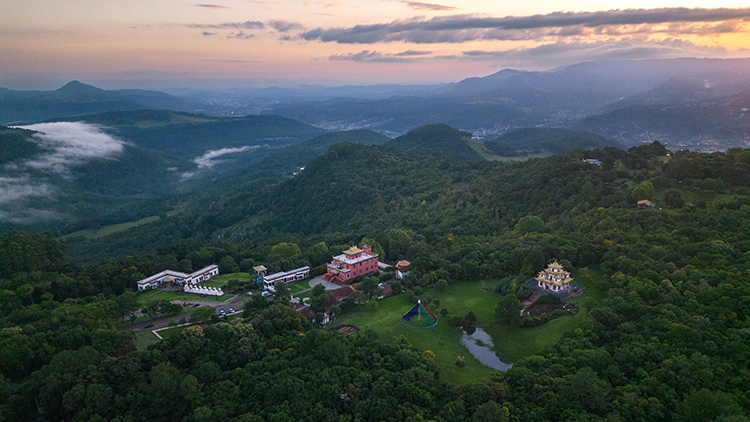
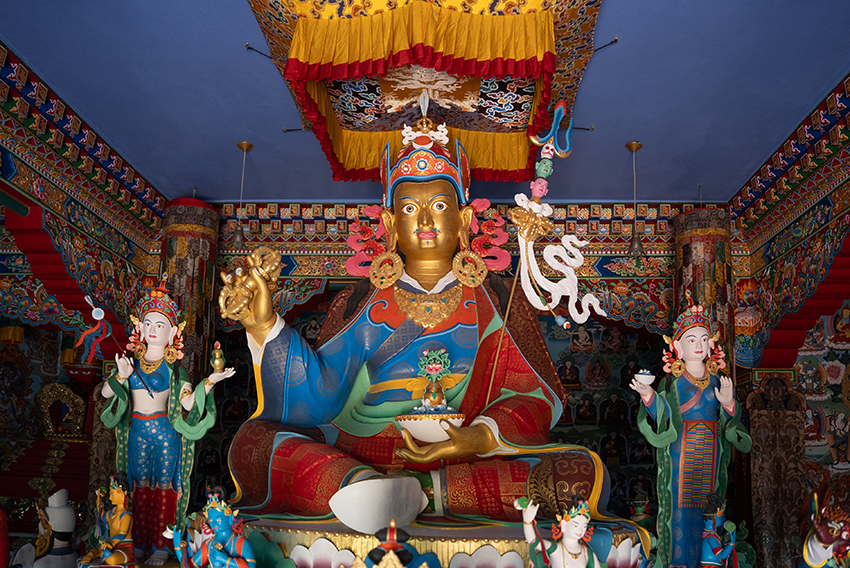
Perched on a hilltop above the small town of Três Coroas in Rio Grande do Sul, Brazil, the Buddhist center (Tib. gonpa) Khadro Ling was established by the Tibetan lama Chagdud Tulku Rinpoche (1930–2002) and his wife, Chagdud Khadro, in 1995. The center is unique in many ways. Its main temple is built in traditional Tibetan style and the center is home to a resident community of mainly Western Buddhists who practice authentically according to the Tibetan Nyingma tradition. Moreover, in his final years, Chagdud Rinpoche conceived the idea to build a replica of the palace of Guru Rinpoche’s Pure Land, Zangdog Palri, on the site—the first of its kind outside Asia. After Chagdud Rinpoche’s passing, the direction of the palace’s construction was taken over by Chagdud Khadro, oriented by Dzongsar Khyentse Rinpoche, and the structure was completed and then ornamented in all its splendor. It was eventually consecrated by several high lineage masters, with Dzongsar Khyentse Rinpoche presiding, in December 2008.
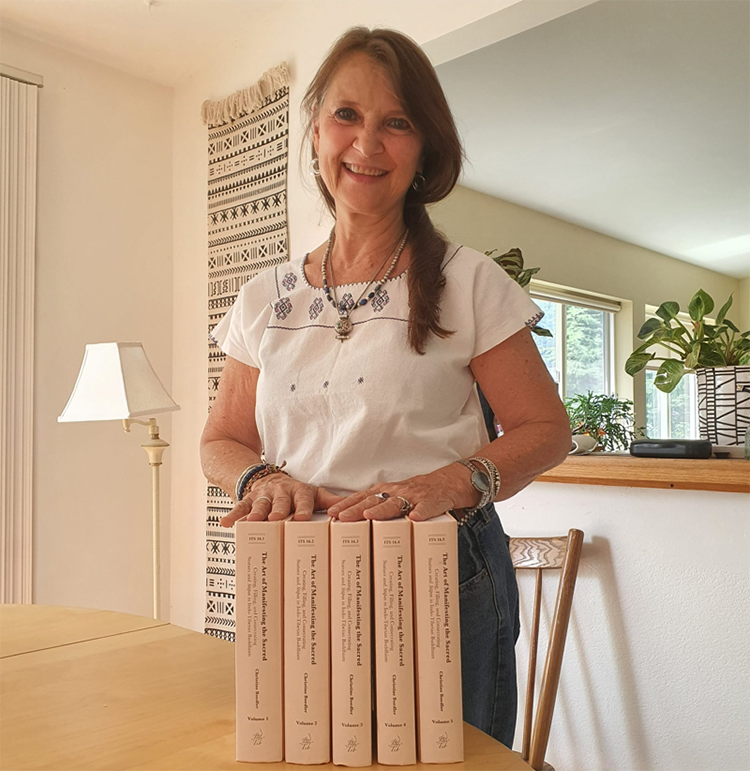
In 2004, Dzongsar Khyentse Rinpoche had asked gonpa resident Christine Boedler to serve as assistant to Lama Rigdzin Samdrub, the Bhutanese yogi and consecration master he would send to Brazil to prepare the palace for the final consecration. Based on a longer video, this is the abbreviated story of Christine’s involvement in the Zangdog Palri project, which later led her to do extensive research at the University of Hamburg. Christine was finally able to copyedit and prepare for publishing her groundbreaking PhD thesis through a Khyentse Foundation Ashoka Grant. Written in English, her five-volume book, titled The Art of Manifesting the Sacred – Creating, Filling, and Consecrating Stupas and Statues in Indo-Tibetan Buddhism, was published in May 2025 and will soon also be available as an e-book in PDF form, accessible free of charge. While primarily intended as a ritual handbook and consecration manual for Western sanghas seeking to erect and consecrate their own sacred structures, its wealth of scriptural translations and ritual instructions is fascinating in itself.
In March 2005, Lama Rigdzin duly arrived at Khadro Ling and Christine and a few other gonpa members set to work. “For the next few years we were involved in an avalanche of mantras, substances, and relics, working 24 hours a day to prepare the artwork of the palace, … the statues and the mandalas that fill the three levels, and then the part that is most hidden—the part of filling all these statues,” says Christine. “Normally you look at the palace and you admire the artwork, but what makes it really sacred, what gives it the power and the energy, this is also the filling, the substances and the relics that are inserted into the statues in a very structured process.”
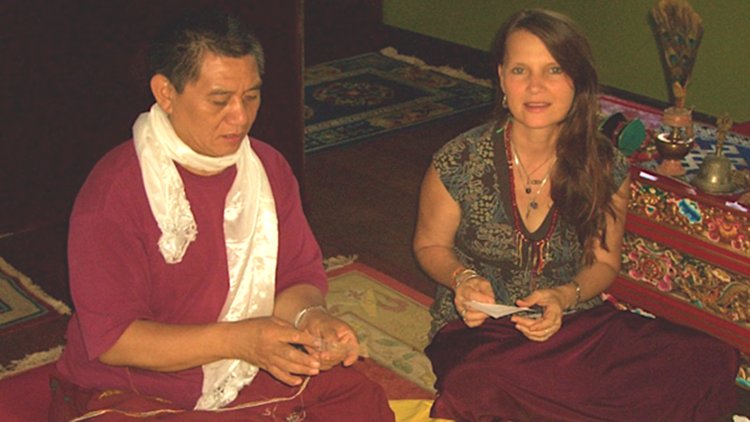
The first step was preparing the mantras, followed by the relics and substances. “Lama Rigdzin brought this whole set of mantras from the Mindrolling Kagyama (the collection of mantras from scriptures gathered at Mindrolling Monastery), and with people from the gonpa, we had to rewrite them for [printing and] insertion because we knew we would need a lot and he couldn’t bring the quantities we would need. This was a big experience. And then the other part was getting all the relics ready. Lama Rigdzin had a huge bag full of mysterious little parcels, so we started wrapping and writing [the names on these parcels] and he would be very secretive about this whole thing, he didn’t really want to tell exactly what was in there. But then, in view of having to put these relics into I think almost a hundred statues, he finally agreed that we could make [printed] labels. Then he was telling, ‘This is this lineage, this is this master, this is this and that.’ The lineage is really important in these consecration activities.
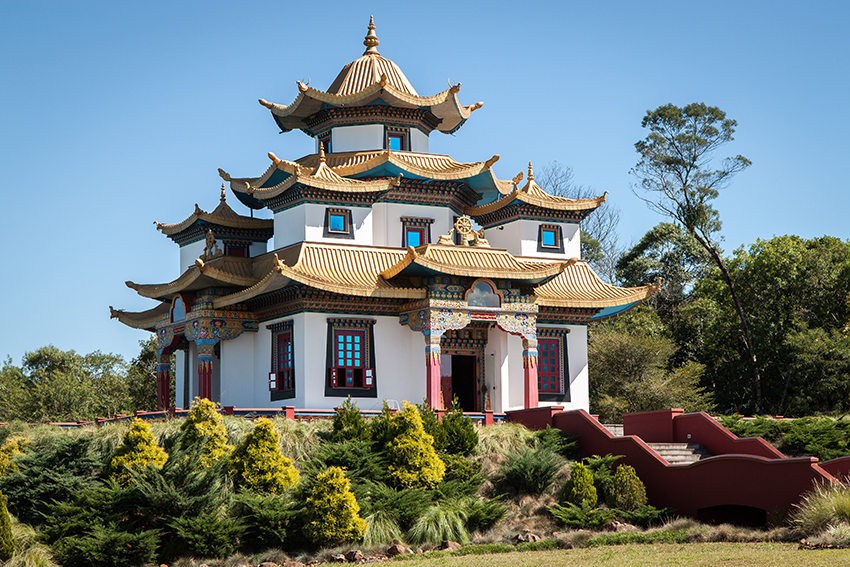
“This is a very special palace in that it’s the first time one has been built outside Asia,” says Christine. “Outside Bhutan [and Tibet], a few were built in India later. So it was a very historical moment. Since we were very few people and I was really the only one that was involved [in the consecration work] the whole time, I felt a huge responsibility to pass on the knowledge of what happened and what went into the statues. Even people in our gonpa don’t know what was done, how it was done, so somehow it came up in the process that I started to really document.
“I knew that there was one text that was kind of Lama Rigdzin’s ‘bible.’ That was Jamgon Kongtrul’s Zung bül lag len (Manual for Dharani and Relic Insertion). This is a very concise, very dense text that he had been checking all the time, and I got the idea that I should really study that text.” So, after the final consecration of the palace in December 2008, Christine decided to go to Dharamsala to improve her Tibetan and to seek help with translating the text and revising her notes.
Christine has managed to view the profound Buddhist consecration rituals and their sacred substances through a truly wide lens and from many angles, even linking them with the quintessential teachings of the Buddha. Reading this book, one gets a real sense of what it means to manifest awakened body, speech, and mind through symbol and art.
Dzongsar Khyentse Rinpoche
In India, she met with Dzongsar Khyentse Rinpoche, who looked at her material and encouraged her to publish it. “I felt he really saw my intention, why I had gathered all this,” she says. “I think he saw the importance that there is a register of a ritual process that is very unique. This is something I noticed also in my studies—there is so much emphasis on philosophy, on Madhyamaka, on all these literary studies, but there is still very little written about what these consecration activities actually are. There’s little material about substances, about relics. It’s all somewhere, in the tantras you find these things, or it’s the domain of the lama. And the problem comes when you bring this knowledge and this ritual to the West. I think one of my main motivations was that we should be empowered, that we should have the knowledge to be able to implement this kind of ritual consciously ourselves. If we only rely on sitting there and saying, ‘Oh, let the lamas come and do everything,’ and then they go and we don’t even know what they did, and we don’t even remember what happened because we just have a cursory look, then I think this is not going to establish the dharma and this is not empowering us to be real lineage holders ourselves and to be conscious of what these rituals are.
“And the thing about ritual—if you transfer it to a different [cultural] context, then people are very prone to say, ‘This isn’t necessary’ and ‘Oh, this step, why do we need this?’ ‘Oh, let’s make it shorter,’ and they start cutting parts of the liturgy or they say, ‘Oh, we don’t need all this stuff inside [the statues].’ So that was something I felt very responsible for.”
In order to prepare her material for publication, in 2010 Christine returned to Germany to pursue a PhD in the Department of Indian and Tibetan Studies at the University of Hamburg.
“When I set out to study, I very quickly came to the point that I thought, okay, it’s not just translating Jamgon Kongtrul’s text but it’s presenting the broader picture. Where do the substances come from, what is there written about the relics, what does the Buddha say about stupas, what does the Buddha say about his relics inside the stupas, what is said in the sutras and in the dharani-sutras about the importance of consecrating stupas, the importance of consecrating and filling statues? These are really very important old texts. Once you start, it’s really an endless process.”
All photos following by Christine Boedler.
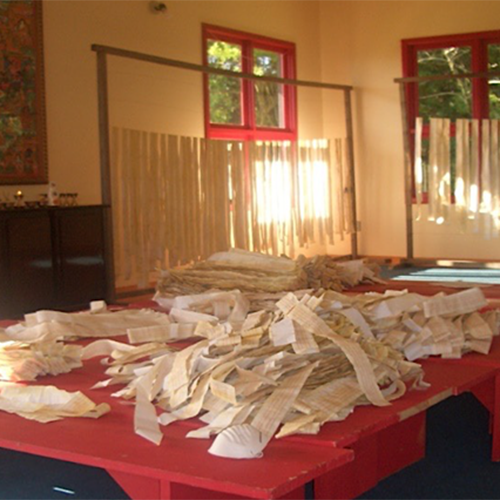
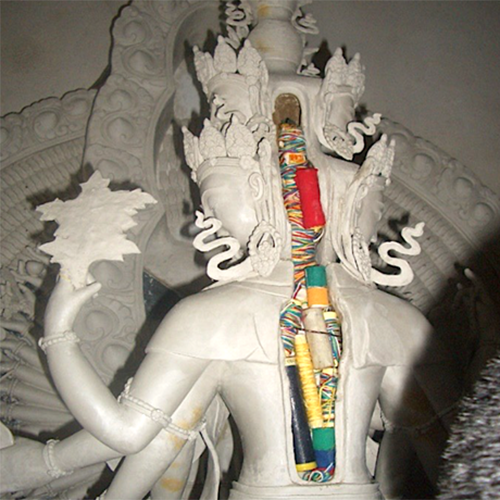
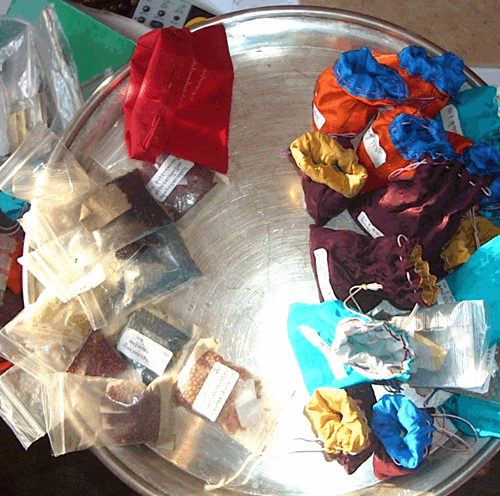
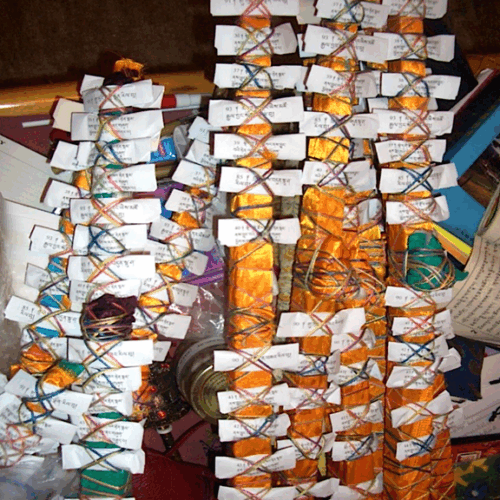
“If you don’t have the scripture that is the basis for the ritual you are performing, then it really remains without the basis. You need to refer to the sacred authoritative text that is the basis for any act, and then you can maybe say, ‘Okay, in Brazil we don’t have this and this substance, it is meant to perform this and this function, maybe we can substitute it.’ You can take a Brazilian fruit, you can take Brazilian ornaments and clothes, but you have to know why you change what, if you can change something.
“In my book, I’ve really tried to identify each and every [canonical] text that Kongtrul mentions in his short text, and also to go into the Terma (‘spiritual treasures’) texts and into the rituals from the Nyingma Termas and the Nyingma procedures, because this is a very specific part.” Why write so much about Guru Rinpoche and the Terma tradition? “It is important because these relics in the case of our Zangdog Palri [palace] all come from tertöns (‘revealers of spiritual treasures’). These are things that have been hidden by Guru Rinpoche [and Yeshe Tsogyal] and discovered by the tertöns, and if you don’t explain as much as possible the concept of Guru Rinpoche hiding and tertöns finding, then you can already question all these things that are put into a stupa or statue.”
What about the introduction? “The introduction has a lot to do with the alchemical tradition, with the transformation of matter and material and with yoga, because all this contributes to the different categories of relics. Moreover, the actual [relic and mantra] insertion is hierarchical, like at the top of the stupa or statue you will put the highest teaching—so then I also wrote about the hierarchical structure of the nine yanas (‘vehicles’) of the teachings and the Nyingma tradition. So actually, when I presented my material, it was always in view of why I’m presenting this. It has to make sense for rituals and procedures that take place when you consecrate statues and stupas.”
Christine hopes her book is a worthy contribution to maintaining the continuity of the Buddhist Vajrayana and its profound ritual legacy, with emphasis on the Nyingma tradition. “I am extremely grateful to Chagdud Tulku Rinpoche, to Dzongsar Khyentse Rinpoche, and to Lama Rigdzin Samdrub, who taught me all this,” she says. “And of course to Khyentse Foundation, which relies on the support of donors. The merit of having this work out there is also theirs.”
The hard copy of the book is ready and can be ordered here. The free e-book will be available soon on the publisher’s Indian & Tibetan Studies Series page.
Featured image above: Christine Boedler with her newly published five-volume book The Art of Manifesting the Sacred. Photo by Ardjani Puig Pedack.