The Jataka School: Rooted in Wisdom, Built for the Future
A New Model of Wisdom for the Modern Child
The sixth issue in our series “Bodhi Seeds,” on education programs and schools that Khyentse Foundation supports, features the Jataka School, a Buddhist international school in Bangkok, Thailand, that is set to open in August 2026.
The sixth issue in our series “Bodhi Seeds,” on education programs and schools that Khyentse Foundation supports, features the Jataka School, a Buddhist international school in Bangkok, Thailand, that is set to open in August 2026.
When Dzongsar Khyentse Rinpoche speaks about education, he often reminds us that a school is a place where one learns about the wholeness of life. He encourages educators to think beyond grades and careers, beyond the narrow metrics of success, and instead to nurture the fundamental qualities that make us human—curiosity, compassion, wonder, and respect for all beings.
This spirit sits at the heart of the Jataka School, a Buddhist international school serving children aged 3–11 that is set to open in Bangkok in 2026. Though its doors are still being built, the vision that animates Jataka is already alive: to reimagine wisdom education in Asia for generations to come.
Rooted in Wisdom, Built for the Future
Rinpoche once said, “In any school I create, we will pay attention to the stories we tell.” The Jatakas are stories—they’re timeless stories recounted by the Buddha that illustrate the workings of cause and effect. But more than that, taken as a collection of hundreds of stories, the Jataka Tales represent the Buddha’s own journey to awakening. The Jataka School aspires to plant the seeds of awakening in each and every child.
There are over 150 international schools in Bangkok, and only a handful of local Thai schools that offer a Buddhist-inspired approach. When the Jataka School opens, blending the British curriculum with the innovative dharma learning framework developed by Middle Way Education, it will become Bangkok’s first Buddhist-based international school.
“Too often here, parents feel they must choose between a strong international education or the Buddhadharma,” says Pema Abrahams, co-founder and project director of the Jataka School. “If Buddhist education remains the alternative option, what chance does the dharma have to truly flourish? Our vision for Jataka is to change that—to create a school that offers the best of both worlds.”
At Jataka, learning is being designed as collaborative, inquiry-oriented, and perhaps most importantly, embodied. Each day is sprinkled with small, mindful pauses, opportunities to explore big philosophical questions, and moments to connect with nature and community. These experiences form what the founders call the school’s Distinctively Jataka approach.
A Vision beyond Western Models
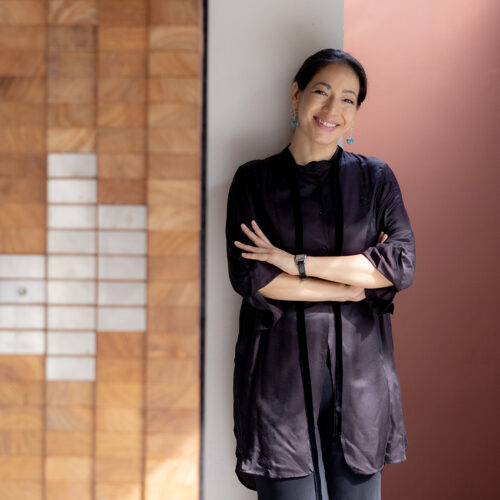
Dzongsar Khyentse Rinpoche has often spoken of the need to distinguish modernization from Westernization. For co-founder Kuhn (Bo) Sucharitakul, the creation of Jataka is both a continuation of a family history in Thai education and a departure into new ground. Bo’s path has taken him from the contemplative halls of Naropa University in Colorado, USA, to the Thai forest monasteries and beyond. As a board member of Middle Way Education, he brings a deep understanding of how Eastern wisdom and Western pedagogical methods can enrich each other.
“With the Jataka School, we are not here to replicate a Western model or enshrine Thai Buddhist culture,” he says. “Our task is to translate timeless values into a living practice that helps children and families exist better in the modern world.”
Furthermore, the Jataka School believes that multilingualism is best acquired through an immersive approach: Students will learn through our school’s languages, learning in English on one day and in Mandarin the next, progressing through rather than repeating content. Our timetable also incorporates Thai language and culture on a daily basis. Led by a skilled and experienced teaching team, students are grouped into multiage learning communities: Snow Lions, Dragons, Tigers, and Garudas. These learning communities foster socio-emotional learning, cooperation, and empathy, and allow students to interact with a wider range of peers.
Alongside developing fluency in a range of communication skills and learning about language, our learners will also develop an understanding of and respect for the diversity of languages and cultures, fostering inclusivity. This approach supports students to become fluent communicators in another world language as they build conceptual understanding in both languages.
Serious about Play
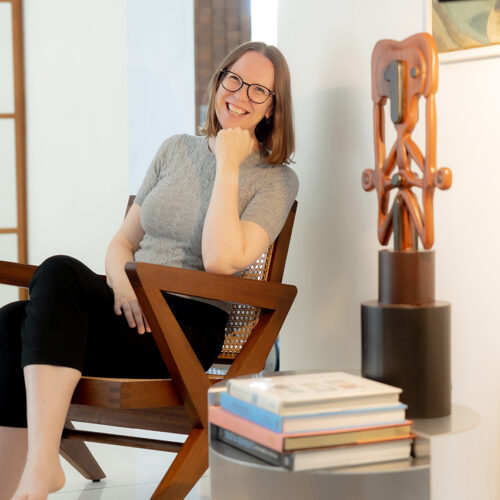
This past August, Dr. Rachael Stevens joined the team as founding principal. She comes to Jataka after 8 years at Panyaden International School, a Buddhist-approach school in Chiang Mai, where she served as vice principal for early years and Buddhist education coordinator. As an educator, a Buddhist practitioner, and a scholar of Buddhism, Rachael is deeply interested in diverse approaches to Buddhist education around the world. A passionate advocate for playful learning, Rachael believes that children learn best through hands-on exploration.
Play sits at the center of Jataka’s philosophy. Inspired by Rinpoche’s own vision of schools where children learn by planting vegetables, making fires, or watching the sky at dawn, Jataka sees play as a gateway to curiosity and awareness.
“What does it mean to be serious about play? For us at Jataka, it means providing extended periods of child-initiated learning for our youngest students,” shares Rachael. “Time where they can discover more about the world and themselves via their interests. It means skilled and experienced teachers supporting them to question and bring learning to them in the moment, nudging them towards their individual next steps. It means an intentionally designed and resourced learning environment that encourages engagement and exploration both indoors and out. As the children grow, it means hands-on learning that encourages inquiry into the concepts that define the human experience. When we talk about the value of playful learning, we couldn’t be more serious.”
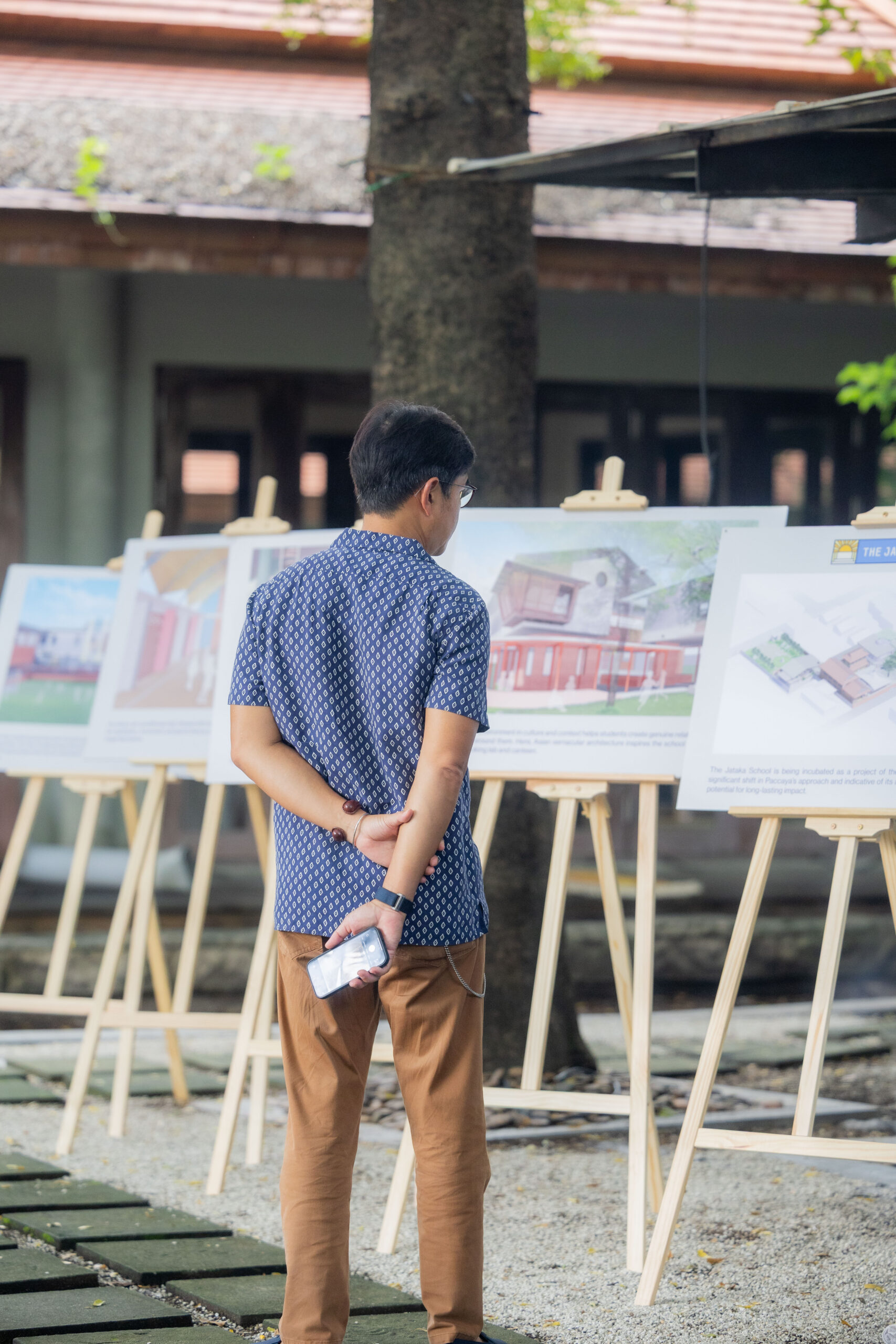
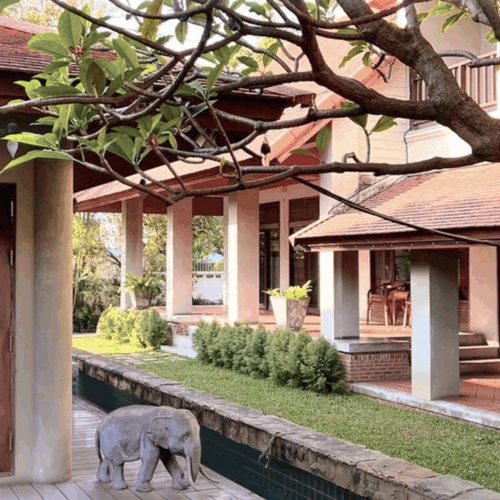
In support of this approach, Jataka’s purpose-built campus, designed by Design Qua (the architects behind Bangkok’s new Jim Thompson Art Center), embraces the Reggio Emilia concept of the environment as the “third teacher.” Classrooms are being designed to flow seamlessly into gardens, courtyards, and ateliers. Every space invites exploration, reflection, and creative engagement.
Children will be encouraged to engage with their environment—to see where their food comes from, to understand that the soil, sun, and rain are all part of their own story. From mindful cooking and eco-sustainability projects to open-air storytelling and art, the school’s programs are playfully designed to make the invisible threads of interdependence visible and alive.
The Middle Way in Education
Partnering with Middle Way Education provides the railings for the child’s path of inner exploration. The framework includes hundreds of age-appropriate goals, each designed to nurture qualities like authentic presence, kindness, self-awareness, and emotional resilience.
By weaving these understandings into everyday activities, Jataka will help children see the Buddhist view of interdependence not as an abstract philosophy but as a lived experience. A simple classroom discussion might lead to a reflection on cause and effect. A nature walk could become an exploration of impermanence. In this way, the dharma becomes something lived rather than taught.
But MWE’s framework is only one way the Jataka School is embedding the dharma. The school is being incubated and will continue to be stewarded by the Thai nonprofit Paccaya Foundation, and through the staffing of a Contemplation & View team, which sits alongside its Teaching & Learning team, the school will ensure that the dharma pervades not just its classrooms but all of its offerings, including its canteen practices, community recycling center, and parent and staff enrichment programs.
A School of Thought, Not an Institution
The Jataka School is not merely the sum of its classrooms—it is a school of thought. Jataka offers a quiet revolution: a model where children have the opportunity to really learn what it is to be human.
As Rinpoche reminds us, “The aim of this education is to refine ourselves so that we will see the world differently, so that we can help others, and through helping others, make ourselves happy and content.” Taking this to heart, Jataka’s founders have built a school where curiosity, creativity, and joy will be central to learning—an environment offering reflection and the full richness of being human.
Join the Jataka Journey
Though the school is still in its early stages, the Jataka School has just posted its first announcements for teacher vacancies and admissions are now open. Follow its Instagram and Facebook pages to stay up-to-date on what’s next!
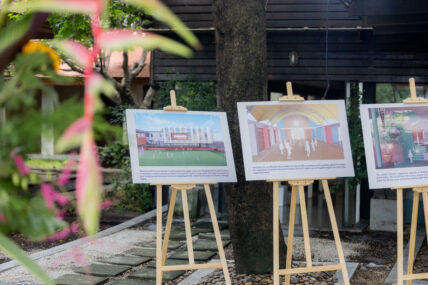
Featured image above: A guest viewing design renders, The Jataka School.
All photos courtesy the Jataka School.